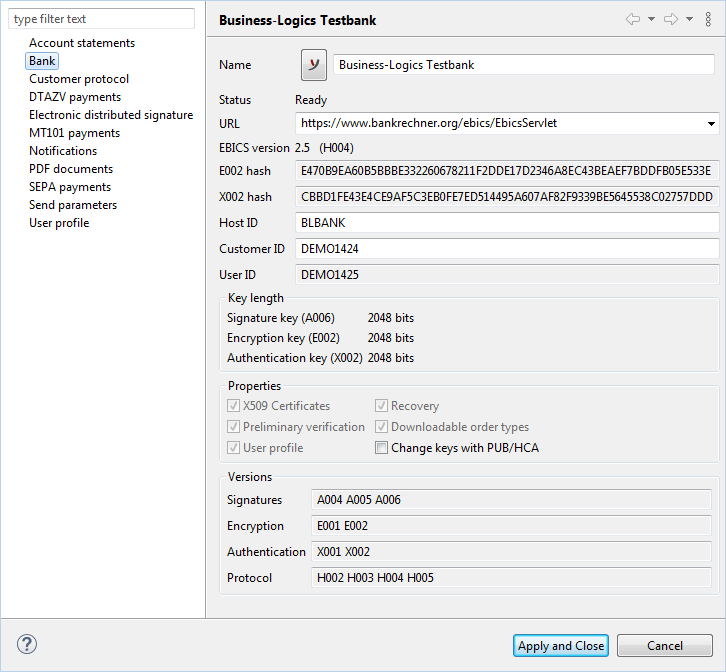
From the overview of Bank connections, you can open a window with the properties of the bank connection by selecting Properties from the context menu of a bank.
The left column of the window contains links to the user profile and several dialog boxes in which settings specifically for this bank can be configured. When you first open the window, the data entered during initial setup is displayed (see Bank connections – Set up bank connection). You can change some of this data later or restore the default values for each dialog box. All properties apply to all users; some can only be edited with administrator rights.
This heading displays the access data required for EBICS communication with this bank. The other dialog boxes are described in the following sections.
Any user can change the name. The name is not necessarily the official name of the bank, but should be assigned in a way that clearly identifies the bank. Alternatively, you can change the name by selecting the bank in the bank connections overview and choosing Edit – Rename.
The icon on the left of the Name field represents the bank in many places of the program, either alone or with the name. Clicking on the icon opens a dialog box in which you can select a different symbol. Use different icons for different bank connections.
In rare cases, the bank changes the general access data to its server. With administrator rights, you can enter the new data here. After that, all users usually have to reinitialize themselves, see Bank connections – Initialize bank connection. The hash values cannot be changed directly in the fields, see Hash values. If the bank has changed your personal Subscriber ID, you can enter it here or during initialization.
The field Subscriber ID can be empty if an administrator has assigned you to the bank in the user administration, but you are not initialized yet. As a user with general permission for bank access, you will see a red cross on the bank symbol in the overview of bank connections. As a user without this permission, initialization is not possible. In this case, this field is not editable and the bank symbol does not display a red cross.
The Country code of the EBICS variant can be set to DE, AT, or CH. You can change the value to switch the default values for send order types or BTFs to those of a different country variant. Manually changed send parameters are retained nevertheless, see Send parameters.
Real-time notifications inform you when fetch data is available so that you do not miss it. The WebSocket service is optional. It is not provided directly by the EBICS server, but by a WebSocket server of the bank. If the bank offers real-time notifications, you can set here how and with which order type a connection shall be established. By default, this is done at program startup with the order type WSS. Users who want to receive real-time notifications require the permission for the order type set here on the bank side.
As soon as real-time notifications are received, their number is displayed in the Status bar. Clicking on the button Display beside opens a dialog box for each real-time notification, where you can start downloading the data. If further actions are associated with the downloaded data, e.g., printing an advice for a received instant transfer, another dialog box is displayed by default. In the preferences, you can specify whether real-time notifications shall be displayed and how the data shall be retrieved concerning file transfers, account information (for payment advice), and EDS. You can disable the display of further notifications in one of the dialog boxes instead of the preferences.
If BL Banking cannot establish a WebSocket connection or loses it, an error icon is displayed in the status bar on the right. Clicking on it displays a WSS Connection Error in a dialog box, and Not connected is displayed instead of the connection time in the properties of the affected bank. Then click on the button Establish connection. Contact the bank if no connection can be established.
The EBICS features of the bank server are displayed here. A checked, grayed-out checkbox means that the bank server supports this feature and the setting cannot be changed in BL Banking. X509 Certificates denotes the version for public keys required for EBICS protocol version H005. Recovery enables you to continue transferring an order after a transport or processing error. Preliminary verification for upload orders enables e.g. account permissions to be checked directly in the first step. Downloadable order types are optionally provided with the administrative order type HAA. A User profile can be viewed in the bank properties, if provided. It is retrieved with the EBICS customer protocol, for which the format can be set under Customer Protocol.
Only this feature for subscriber keys can be changed in the Properties area. Only check the box if you have been informed of a corresponding configuration of the EBICS server. A key change is then carried out with two messages of the order types PUB and HCA instead of one HCS order, see Bank connections – Renew keys.
Configured key lengths and versions supported by the bank server are displayed here for informational purposes only. The key lengths can be changed with the EBICS protocol version, and the signature version can be changed by renewing the keys. For more information on these actions, see Bank connections.
Figure: Display access data for a bank
When a bank changes its access data, this usually also includes the hash values. Select the bank and choose Update from the context menu. In the subsequent dialog box, compare the received hash values with those you actually received from the bank. If they match, click Yes. The new values are saved and the window will not appear anymore. If the values do not match, cancel the action and contact the bank.
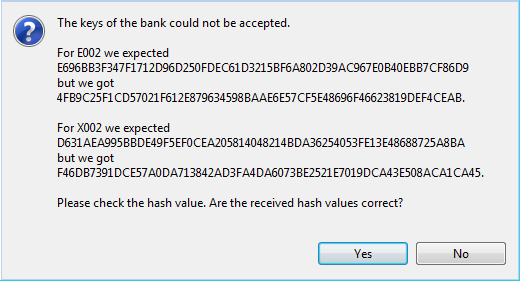
Figure: Window for checking the hash values