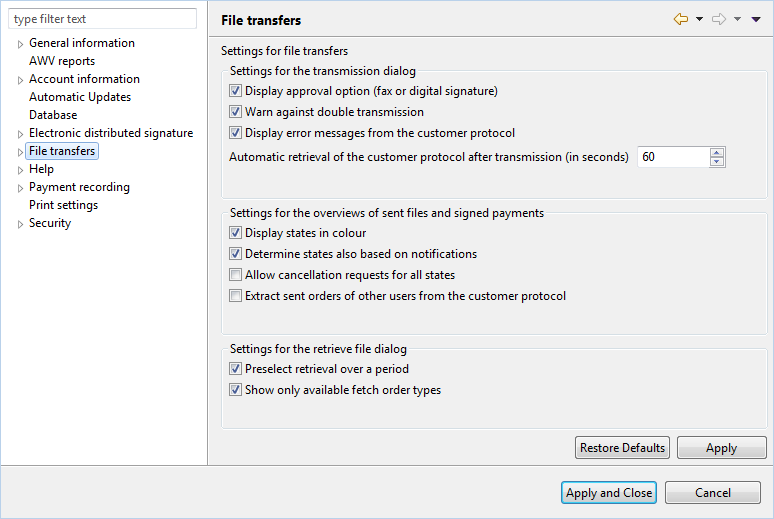
When active, payment files are also possible without electronic signature. The application process gives you the option to print the accompanying ticket for a manual signature.
A corresponding warning is displayed if you are trying to transmit a file to the bank that you have already transmitted previously.
If, after submitting a file, the bank detects an error, it will be immediately reported in a window. This prevents that errors remain undetected, because they are only displayed in the overview after the status has been updated.
When sending external SEPA files, a warning is displayed by default if the file contains a scheme that is no longer supported, e.g., the outdated formats pain.001.003.03 or pain.008.003.02 for transfers and direct debits. You can still submit the file, but the bank may reject it. If you do not want to receive a warning, uncheck the box here. This is an alternative procedure:
Import payments from an external file
The imported payments are submitted using the scheme set in the send parameters of the bank properties.
Here you can set the time in minutes, which should pass after a file transfer, until the Status is updated in the overview Sent files. The update is performed by retrieval of the customer protocol. With the values 0 the update is deactivated. In this case you can manually update the Status in the overview Sent files.
With the checkbox set, sent files and signed payments are displayed in different colors depending on their state.
If this checkbox is set, states from status notifications are shown for sent files and signed payments.
Orders that have already been submitted to the bank and are fully signed may be recalled if this is supported by the bank. With this checkbox set, orders that are in a state other than Signatures complete can also be recalled. This may be necessary if, for example due to a technical fault, the customer protocol cannot be retrieved from the bank and therefore the actual state of the order is unknown.
When active, also the orders sent by other users are displayed with the aid of the customer protocol under Sent files. If this setting is not active, only your own transmissions are displayed.
If the checkbox is marked, the option Over a period of is preset in the dialog box Retrieve file from the bank. If you remove the mark, From the current allocation is preset, when the window is opened.
When active, only the retrieval order types returned back from the banks by means of HAA retrieval (retrievable order types) are selectable for file retrieval. If this flag is removed, you can select all EBICS retrieval order types but you may see an error message when the bank does not provide this order type.
Banks can use real-time notifications to inform you that data is ready for retrieval. A web socket connection to the EBICS bank server is a prerequisite for receiving real-time notifications. Check in the bank properties whether this connection has been established, see Real-time notifications via WebSocket under Bank properties – Bank. Whether and how many real-time notifications are available is displayed in the status bar. You can view these by clicking on Display. Each notification is displayed in a dialog box in which you can decide whether the data provided should be downloaded. Retrieved files can then be found in the view Orders, in the view Account statements and in the EDS.
Preferences for real-time notifications from the areas account information and EDS can be found under other menu items in the preferences:
By default, the notification for payments (Payment Status Report in pain.002 format) always contains the question whether the status report should be retrieved. You can set the desired retrieval action here instead of the question so that you do not have to select it each time in the notification.
Notifications are displayed by default for all other order types or BTFs, e.g. VOP verification results, EBICS customer protocols, EDS overviews and credit advice notes for instant transfers. You can switch off the display of all these notifications here. Alternatively, you can switch off the further display of notifications in every dialog that is displayed for a notification.
You can choose whether and how notifications in view A should be retrieved automatically. If you switch off both automatic retrieval options, you must manually select Retrieve notifications from the menu Actions.
When activated, notifications are retrieved the first time the tab Notifications is opened.
Notifications are collected if you select Refresh from the toolbar or the context menu when the tab Notifications is open in the view Orders.
Figure: Preferences - File transfers