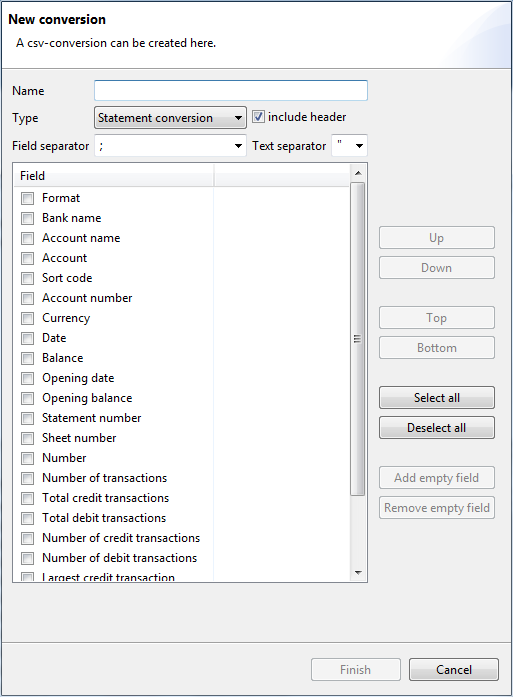
Figure: Dialog box to create a new conversion
Conversions can be selected instead of the original format for account information in both automatic and manual exports, as described in the chapter Account statements – Export. Their purpose is to export account information to CSV format. The Conversions tab displays all saved conversions. To create a new conversion, select the menu item File – New – Conversion. To edit a conversion, select it and choose Edit – Properties.
BL Banking includes sample conversion files (statement.txt, transactions.txt, and balances.txt). These are provided as suggestions, not as mandatory standards, and are therefore not read-only. You can use the sample conversion files directly or as templates for your own conversions. You can restore the original sample conversions after you have renamed or deleted them. To do this, select any or no row on the Conversions tab and choose Create default conversions from the context menu. This menu item is not available if you have edited the sample conversion without changing its original name.
You can create a variant or test changes by copying a conversion. To do this, select a row on the tab and, from the Edit menu, choose Copy and then Paste, or use the keyboard shortcuts Ctrl+C and Ctrl+V. The copied conversion is automatically named using the name of the template, followed by a period and a number, e.g., statement.txt.1. You can delete conversions that are no longer needed by selecting one or more rows and choosing Edit – Delete.
In the dialog box, you can specify how CSV files are structured based on this conversion.
Enter a unique name or change the existing one. Choose a descriptive name so that you can easily identify the desired conversion during export. For automatic exports, this name can be used as part of the name for the output file.
Before selecting fields, you must choose the type from the dropdown list. The type Statement conversion is selected by default; Transactions conversion is also available. The list of selectable fields changes accordingly. Sales conversion includes significantly more fields, including specific ones.
If you activate this checkbox, the first row includes the field names of the output file.
A field separator is a character that separates fields from one another during conversion to CSV format. The default is a semicolon. You can select a different character from the dropdown list or enter any character. Characters that occur in field contents, such as numbers and letters, are not suitable. Although a comma is commonly used, it may not be used if it is a decimal separator within the content. Export files with incorrectly selected separators cause errors during import, so that, for example, no data or incorrect data is received in financial accounting.
A text separator is a character that encloses text and separates it from other data types, such as numbers. The default is double quotation marks. You can select a different character from the dropdown list or enter any character. A text separator is optional, but is usually necessary.
Define the desired format with placeholders and any separator. To preview the result, the current date is displayed in the specified format in the example field next to it. The letters d, M, and y stand for day, month, and year. Note that uppercase and lowercase letters matter. The number of letters changes the format. For example, M stands for a single-digit month, MM for a two-digit month, and MMMM for the name of the month, e.g., 4, 04, or April. The placeholder yy generates the year without the thousands digit; a single y is sufficient for the full year.
Select all fields that you want to appear as columns in the output file. There is no preselection or default setting. The target application—such as financial accounting—determines which fields are required. Therefore, it may be necessary to select fields for which no content is available in the account information, or empty fields that do not exist here in the selected type. The sequence in which the fields are displayed corresponds to the column sequence in the output file.
For transactions, you can select the field Database ID. This is a unique identifier that is written to the CSV file during export to prevent confusion with existing transactions during subsequent processing.
To change the sequence, select the desired field and use these buttons to move it step by step to the desired position.
These buttons can be used to move a field to the very beginning or the very end.
If you want to include all fields as columns in the output file, click the Select all button. To start from scratch, click Deselect all.
You can insert an empty field into the output file as a placeholder for a column that is expected at a specific position when the file is imported into another program. An empty field ensures that the other fields are positioned correctly and that the file can be imported successfully. You only need an empty field if it is not included in the list.
Select the field above which you want to insert the blank field, then click the button Add empty field. To remove an empty field, select it and click the button Remove empty field.
If you have activated the checkbox Include header for a conversion, the corresponding columns in the output file are labeled as Empty field.
Figure: Dialog box to create a new conversion